
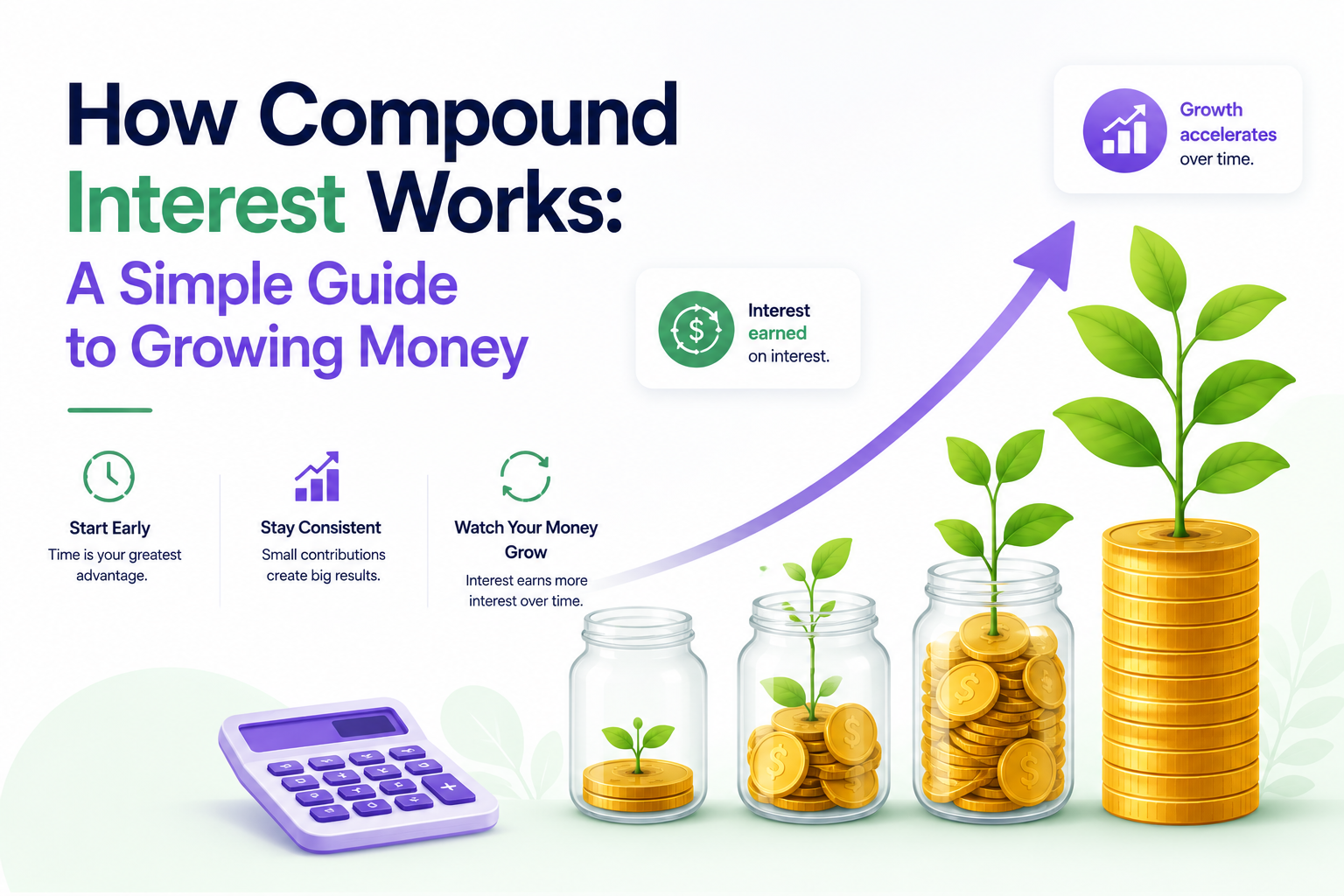
How Compound Interest Works
Compound interest is one of the most important ideas to understand when learning how money can grow over time. Unlike simple interest, which is generally calculated only on the original amount, compound interest can build on both the original amount and the interest that has already accumulated. This means that your money can potentially grow faster as the accumulated interest becomes part of the amount used to calculate future interest.
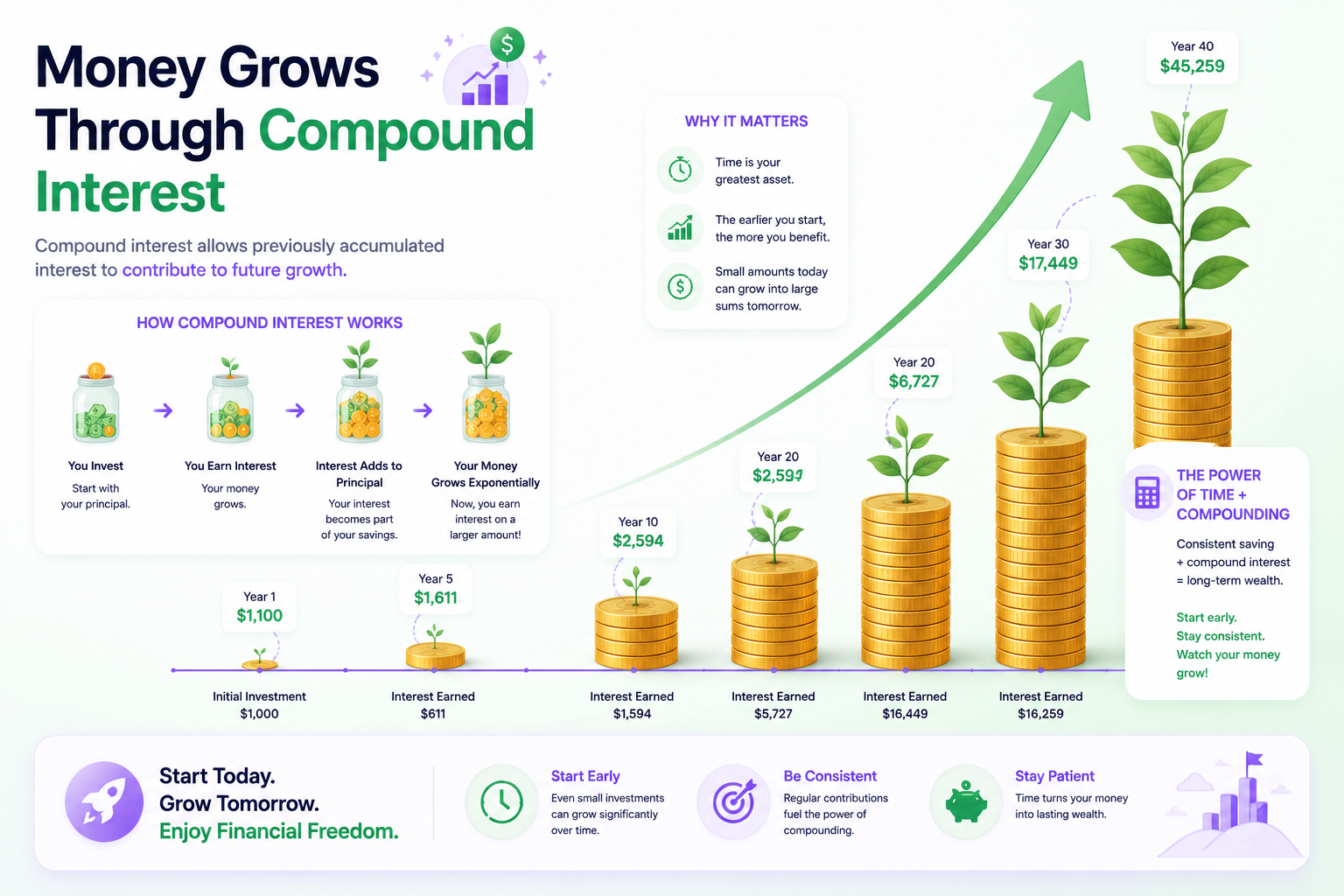
The basic idea is straightforward. You start with an original amount, often called the principal. Interest is then added to that amount. In the next compounding period, interest can be calculated on the original principal plus the interest that was previously added. Over time, this repeated process can create a snowball effect.
For example, imagine you deposit money into an account that earns interest. During the first period, the account earns interest on the original deposit. If that interest remains in the account, the balance becomes larger. During the next period, interest can then be earned on this larger balance. The process continues for as long as the money remains invested or deposited and continues to earn interest.
This is why compound interest is often described as "interest on interest." The phrase does not mean that interest is calculated in a completely different way each time. Instead, it describes what happens when previously earned interest remains in the account and becomes part of the balance on which future interest is calculated.
Compound interest becomes especially powerful over longer periods. At first, the growth may appear relatively slow because the accumulated interest is still small. As time passes, however, the balance can become larger, and the interest earned during each subsequent period can also become larger.
Understanding this process can help you make better decisions about saving, investing, borrowing, and financial planning. It can also help explain why starting to save earlier can be valuable and why carrying interest-bearing debt for a long time can become expensive.
In this guide, we will explain how compound interest works step by step, look at the formula used to calculate it, and walk through examples of how an original amount can grow as interest is repeatedly added. We will also compare compound interest with simple interest and explain how the interest rate, time period, and compounding frequency can affect the final result.
Whether you are trying to understand savings growth or the cost of borrowing, the key principle is the same: the timing and treatment of interest can have a significant effect on how quickly a balance grows over time.
What Is Compound Interest?
Compound interest is interest calculated on an original principal amount as well as the interest that has accumulated during earlier periods. Instead of treating the original principal as the only amount that can earn interest, the calculation can include previously earned interest once it has been added to the balance.
To understand the concept, imagine that you place ₹10,000 into an account earning interest. During the first compounding period, the account earns interest on the ₹10,000. If the interest remains in the account, the balance becomes larger than ₹10,000. During the next period, the interest calculation can be based on this new balance.
Suppose the first period adds ₹500 in interest. The balance would then become ₹10,500. If another period of interest is calculated using the ₹10,500 balance, the second period's interest is not based only on the original ₹10,000. It is based on the larger accumulated amount.
This repeated increase in the amount earning interest is what creates the compounding effect. The longer the process continues, the more noticeable the difference can become, particularly when the interest remains invested rather than being withdrawn.
The Three Basic Parts of Compound Interest
Compound interest calculations are usually based on three fundamental factors: the starting amount, the interest rate, and the amount of time the money remains invested or borrowed. The frequency at which interest is compounded can also affect the final result.
1. Principal
The principal is the original amount of money. If you deposit ₹50,000, the initial principal is ₹50,000. If you borrow ₹5,00,000, the initial loan principal is ₹5,00,000.
A larger principal gives the interest calculation a larger starting base. If two accounts have the same interest rate and compounding frequency, the account with the larger principal will generally earn more interest in monetary terms.
2. Interest Rate
The interest rate determines how much interest is applied to the balance during a particular period. It is commonly expressed as an annual percentage rate.
A higher rate can result in faster growth when you are earning interest, assuming the other factors remain unchanged. On the other hand, a higher rate can make borrowing more expensive when interest is charged on debt.
3. Time
Time is one of the most important parts of compounding. The longer money remains subject to compound growth, the more opportunities there are for accumulated interest to become part of the balance and generate additional interest.
This is why compound interest can look modest during the early years and become much more noticeable over longer periods. The growth does not simply depend on the initial amount; it also depends on how long the accumulated balance continues to compound.
4. Compounding Frequency
Compounding frequency describes how often interest is added to the balance for the purpose of calculating future interest. Depending on the account or financial product, compounding may occur annually, semi-annually, quarterly, monthly, or at another specified frequency.
When other factors are held constant, more frequent compounding can result in a different final balance because interest is incorporated into the balance more frequently.
Why Compound Interest Can Accelerate Growth
The key difference between earning a fixed return on the original amount and compound growth is that the amount generating interest can increase over time. Each period can add to the balance, and that larger balance can become the basis for future interest calculations.
This creates a cumulative effect. In the beginning, most of the balance may come from the original principal. As time passes, an increasing portion of the balance can come from accumulated interest. The result is that growth can become more noticeable as the compounding period continues.
Compound Interest Formula and How It Works
A standard compound interest formula can be used to estimate how a lump sum grows when interest is compounded at regular intervals. The formula helps show the relationship between the starting amount, interest rate, and number of compounding periods.
In this formula, FV represents the future value of the money, while PV represents the present value or starting principal. The variable r represents the interest rate for each compounding period, and n represents the total number of compounding periods.
The formula demonstrates an important feature of compound interest: the starting amount is multiplied by a growth factor repeatedly over the number of compounding periods. As the number of periods increases, the effect of repeated growth becomes increasingly important.
Understanding the Principal in the Formula
The principal is the amount you start with. For a savings or investment example, this could be the amount you initially deposit. For a loan, it could represent the amount borrowed before considering interest.
If the principal increases while the interest rate and time remain the same, the final value will generally increase as well. This is why the amount invested or deposited at the beginning can have a meaningful effect on the eventual result.
Understanding the Interest Rate
The interest rate determines the rate at which the balance grows during each compounding period. If an annual rate is being used with annual compounding, the annual rate can be used as the rate for each period. When compounding happens more frequently, the rate used for each period needs to correspond to that compounding period.
It is important to distinguish between the stated annual rate and the rate actually applied during each individual compounding period. Financial products can use different conventions, so the terms of the specific account or investment should always be checked.
Understanding the Number of Periods
The number of periods represents how many times the growth calculation occurs. If interest compounds once per year for ten years, there are ten compounding periods. If it compounds more frequently, the total number of periods increases accordingly.
This is one reason time can have such a strong effect on compound growth. Increasing the number of compounding periods gives the accumulated balance more opportunities to generate additional growth.
A Simple Way to Think About the Formula
You do not need to memorize the formula to understand the main concept. Think of compound interest as a repeating cycle: start with a balance, calculate interest, add that interest to the balance, and then use the updated balance for the next period.
The first period starts with the original principal. The second period starts with the original principal plus the first period's accumulated interest. The third period starts with an even larger balance if the interest continues to remain in the account. This cycle is repeated throughout the selected period.
Why the Growth Is Not Linear
With simple interest, the interest may be calculated only on the original principal, so the amount of interest added during each equivalent period can remain the same when the rate and principal are unchanged.
Compound interest behaves differently because the balance can increase after each compounding period. When the balance increases, the amount available to generate future interest can also increase.
This is why compound growth is often described as exponential rather than simply linear. The effect becomes increasingly significant as the number of periods grows, which is one of the main reasons compound interest is so important in long-term financial planning.
Example: How Compound Interest Builds on Your Original Amount
A numerical example makes the compounding process easier to understand. Suppose you start with ₹10,000 and earn 10% annual interest, with the interest compounded once each year. For simplicity, assume that you do not withdraw any interest during the period.
During the first year, the account earns 10% of the original ₹10,000. That produces ₹1,000 in interest, bringing the balance to ₹11,000 at the end of the first year.
During the second year, the calculation is no longer based on only ₹10,000. The balance has become ₹11,000, so 10% interest produces ₹1,100. The new balance becomes ₹12,100.
During the third year, the starting balance is ₹12,100. At a 10% annual rate, the interest for that year is ₹1,210, resulting in a balance of ₹13,310.
| Year | Starting Balance | Interest at 10% | Ending Balance |
|---|---|---|---|
| 1 | ₹10,000 | ₹1,000 | ₹11,000 |
| 2 | ₹11,000 | ₹1,100 | ₹12,100 |
| 3 | ₹12,100 | ₹1,210 | ₹13,310 |
Notice what happens to the interest earned each year. In the first year, the interest is ₹1,000. In the second year, it increases to ₹1,100. In the third year, it increases again to ₹1,210. The interest itself is becoming part of the balance and helping generate additional interest.
The First Year of Growth
At the beginning, the account contains ₹10,000. At a 10% annual rate, the first year's interest is ₹1,000. Once that interest is added, the balance becomes ₹11,000.
At this stage, the additional ₹1,000 may not seem dramatic. However, that extra amount is now part of the balance. If it remains invested, it can participate in future growth.
The Second Year of Growth
The second year starts with ₹11,000 rather than ₹10,000. The 10% interest is therefore ₹1,100. After the interest is added, the balance becomes ₹12,100.
The important point is that the second year's interest is larger than the first year's interest even though the interest rate has not changed. The difference comes from the larger balance created by the previous year's interest.
The Third Year of Growth
By the third year, the balance has reached ₹12,100. Applying the same 10% rate produces ₹1,210 in interest, bringing the balance to ₹13,310.
Again, the interest earned during the year has increased even though the interest rate remains exactly the same. This illustrates the core principle of compound interest: the balance can grow because previous interest remains part of the amount being compounded.
Why the Difference Becomes Larger Over Time
In the early years, the additional growth from compounding may seem relatively small. As more periods pass, however, the accumulated interest becomes a larger part of the balance.
This means future interest can be calculated on a progressively larger amount. The effect can become much more significant over long periods than it appears from looking at only the first few years.
That is the main reason time is so important when understanding compound interest. The longer the compounding process continues, the more opportunity accumulated interest has to contribute to future growth.
Compound Interest vs Simple Interest: What Is the Difference?
Compound interest and simple interest both describe ways of calculating interest, but they treat the accumulated interest differently. The main difference is the amount on which future interest is calculated.
With simple interest, interest is generally calculated using the original principal. If the principal, interest rate, and time remain unchanged, the interest earned during each equivalent period can remain the same. The accumulated interest does not normally become part of the principal for calculating additional interest.
Compound interest works differently. When accumulated interest remains in the account and becomes part of the balance, future interest can be calculated on that larger amount. This creates the compounding effect that can cause growth to accelerate over time.
| Feature | Simple Interest | Compound Interest |
|---|---|---|
| Interest Basis | Usually the original principal | Principal plus accumulated interest |
| Effect of Previous Interest | Does not normally generate additional interest | Can contribute to future interest |
| Growth Pattern | Generally linear | Can accelerate over time |
| Importance of Time | Important | Particularly significant over long periods |
A Simple Interest Example
Suppose you have ₹10,000 earning 10% simple interest per year. The interest calculated each year would be based on the original ₹10,000. At 10%, that would mean ₹1,000 of interest for each year under the simplified example.
After three years, the accumulated interest would be ₹3,000, making the total amount ₹13,000, assuming there are no withdrawals, additional contributions, or other changes.
A Compound Interest Example
Now consider the same ₹10,000 earning 10% annual compound interest. During the first year, the account earns ₹1,000 and reaches ₹11,000. During the second year, the 10% calculation applies to ₹11,000, so the interest becomes ₹1,100 and the balance reaches ₹12,100.
By the third year, the balance is ₹12,100. Another 10% produces ₹1,210 in interest, resulting in ₹13,310.
In this simplified comparison, the compound-interest balance after three years is ₹13,310, compared with ₹13,000 under simple interest. The difference is created by the interest earned on previously accumulated interest.
The difference may look small over only a few years. However, as the number of compounding periods increases, the gap can become much more noticeable. This is why the distinction between simple and compound interest becomes particularly important when analyzing long-term financial growth.
How Interest Rate, Time, and Compounding Frequency Affect Growth
Compound interest does not depend on a single number. The final amount can be influenced by several factors, including the starting principal, interest rate, investment period, and frequency with which interest is compounded.
Understanding each factor can help you make better comparisons between different financial products and understand why two accounts with the same starting amount may produce different results.
The Effect of the Starting Amount
The starting principal provides the foundation for compound growth. If you begin with a larger amount and the interest rate, time, and compounding frequency remain the same, the resulting balance will generally be larger.
For example, an account starting with ₹20,000 has twice the initial principal of an account starting with ₹10,000. If both receive the same percentage rate under the same conditions, the larger starting balance will generally produce a larger amount of interest in monetary terms.
The Effect of the Interest Rate
The interest rate determines how quickly the balance can grow during each compounding period. A higher rate can produce greater growth when all other factors remain unchanged.
The effect of the rate can become increasingly important over long periods because the additional interest also has an opportunity to compound. This means that even a seemingly modest difference in rates can have a meaningful effect when applied repeatedly for many years.
The Effect of Time
Time gives compound interest an opportunity to repeat the growth cycle. Every additional compounding period gives the accumulated balance another opportunity to generate interest.
This is why compound growth can look relatively slow at the beginning and become more significant later. The balance is not only growing from the original contribution; the accumulated interest can also become part of the growth process.
The Effect of Compounding Frequency
Compounding frequency refers to how often interest is added to the balance. Common frequencies include annual, semi-annual, quarterly, monthly, and daily compounding, depending on the financial product.
When interest compounds more frequently, previously accumulated interest can become part of the balance more often. With the same stated annual rate and other assumptions, this can result in a different final amount compared with less frequent compounding.
However, the exact effect depends on the way the financial product defines and applies its interest rate. When comparing accounts, it is therefore useful to look at the effective return or equivalent measure provided by the institution rather than relying only on the headline interest rate.
Why All Four Factors Matter Together
Principal, interest rate, time, and compounding frequency should not be viewed separately. A small starting amount can grow substantially if given enough time, while a larger starting amount can produce greater growth over the same period. Likewise, the interest rate and frequency of compounding can influence how quickly the balance increases.
Why Starting Early Can Make Compound Interest More Powerful
One of the biggest advantages of compound growth is the role of time. When money remains invested or deposited for a longer period, there are more opportunities for accumulated interest to become part of the balance and generate additional growth.
Consider two people who want to build a long-term savings balance. One begins contributing earlier and gives the money more years to compound. The other starts later and may need to contribute more aggressively to reach a similar target in a shorter period.
Starting early does not guarantee a particular investment outcome. Actual returns can vary depending on the financial product and market conditions. The important mathematical idea is that a longer period gives compound growth more time to operate.
Time Can Matter More Than a Large Initial Contribution
People often focus on how much they need to save today, but the timing of contributions can also be important. Money contributed earlier has more time to potentially generate returns and for those returns to participate in future growth.
This does not mean that later contributions are unimportant. It means that delaying the start of saving reduces the amount of time available for compounding. A longer investment horizon can give the accumulated balance more opportunity to grow.
Consistency Can Strengthen the Effect
Compound growth can become even more meaningful when regular contributions are added to an account. Each new contribution increases the amount available to potentially earn future returns.
The exact result will depend on contribution timing, interest or return rates, fees, taxes, and the specific financial product. Nevertheless, the basic principle remains useful: starting earlier and allowing accumulated returns to remain invested can give compounding more time to work.
How Compound Interest Works in Savings and Investments
Compound interest is particularly useful for understanding how savings and certain investments can grow over time. When earnings remain in an account instead of being withdrawn, those earnings can contribute to the balance used for future growth.
For a savings account, the institution may credit interest to the account according to its terms. If the interest remains in the account, the balance can increase. Future interest may then be calculated using the higher balance, depending on the product's rules.
Reinvesting Earnings
Reinvestment is an important part of compounding. If earnings are withdrawn regularly, they are no longer part of the account balance and cannot generate additional returns within that account.
When earnings are left invested, they remain part of the amount that can potentially generate future returns. Over a long period, this can make a significant difference compared with regularly removing the earnings.
Compound Growth Does Not Mean Guaranteed Growth
It is important to distinguish the mathematical concept of compounding from the performance of a particular investment. Compound interest calculations assume a specified rate and compounding method.
Actual investment returns can fluctuate, and some investments do not provide a fixed rate of return. Fees, taxes, inflation, market movements, and withdrawals can also affect the actual amount you end up with.
Therefore, compound interest is best understood as a financial principle rather than a promise that every investment will grow at a particular rate.
How Compound Interest Works on Loans and Debt
Compound interest can work in the opposite direction when you are the borrower. Instead of helping an account grow, interest can increase the amount you owe when unpaid interest is added to the balance and future interest is calculated on the increased amount.
The exact treatment of interest depends on the type of debt and the lender's terms. Not every loan operates as a straightforward compound interest calculation. Some loans use amortization schedules, while other products may calculate interest differently.
Why Unpaid Interest Can Increase Debt
If interest is added to an outstanding balance, the amount owed can increase. If future interest is then calculated using that increased balance, the borrower can effectively experience a compounding effect.
This is one reason it is important to understand the terms of credit cards, loans, and other interest-bearing debt. A borrower should know how interest is calculated, when it is charged, and what happens when payments are missed or delayed.
Paying Interest Does Not Always Reduce Principal Immediately
For many loans, a payment can be divided between interest and principal. Early payments may contain a larger interest component, depending on the loan structure and outstanding balance.
This is why borrowers should not judge a loan solely by its monthly payment. Understanding the interest rate, repayment schedule, total interest, and outstanding balance can provide a much clearer picture of the actual borrowing cost.
Common Mistakes People Make When Understanding Compound Interest
Compound interest is conceptually simple, but several common mistakes can lead to incorrect expectations. Understanding these mistakes can help you interpret compound growth more realistically.
Mistake 1: Assuming the Rate Is Guaranteed Forever
A compound interest calculation often assumes that the interest rate remains unchanged for the entire period. Real financial products may have variable rates or changing returns. Always check whether the quoted rate is fixed or subject to change.
Mistake 2: Ignoring Fees and Taxes
A theoretical compound interest calculation may not include account fees, investment expenses, taxes, or other deductions. These costs can reduce the amount that actually remains available for future growth.
Mistake 3: Withdrawing the Interest Too Often
If the goal is to benefit from compounding, withdrawing accumulated interest removes part of the balance that could otherwise contribute to future growth.
Mistake 4: Looking Only at the Interest Rate
Two financial products may advertise similar rates but have different compounding schedules, fees, minimum balances, withdrawal restrictions, or other conditions. The complete terms should be considered before making a financial decision.
Mistake 5: Underestimating the Importance of Time
Some people expect compound growth to become dramatic immediately. In reality, the early stages can look relatively slow. Much of the power of compounding comes from allowing the process to continue for a sufficiently long period.
Best Practices for Making Compound Interest Work for You
Understanding compound interest is useful, but applying the concept effectively requires consistent financial habits. The following practices can help you make better use of the principle of compounding.
Start as Early as Practical
Starting earlier gives your money more time to potentially compound. Even if the initial amount is modest, a longer time horizon can provide more opportunities for accumulated earnings to contribute to future growth.
Make Contributions Consistently
Regular contributions can increase the amount of money participating in long-term growth. The exact strategy depends on your financial circumstances and the account or investment being used.
Reinvest Earnings When Appropriate
When your objective is long-term growth, allowing earnings to remain invested can give them an opportunity to generate additional returns. This is the basic mechanism behind compounding.
Understand the Product Before Choosing It
Look at more than the advertised interest rate. Check the compounding frequency, fees, withdrawal conditions, rate changes, taxes, and other terms that may affect the actual result.
Use a Compound Interest Calculator
A compound interest calculator can make it easier to compare different scenarios. You can change the starting amount, interest rate, time period, compounding frequency, and additional contributions to see how each factor can affect the projected future value.
Frequently Asked Questions
1. What Is Compound Interest in Simple Terms?
Compound interest is interest calculated on an original amount and, after previous interest has been added to the balance, on the accumulated amount as well. This allows previously earned interest to contribute to future interest growth.
2. What Is the Difference Between Simple and Compound Interest?
Simple interest is generally calculated using the original principal, while compound interest can be calculated using the principal plus accumulated interest. As a result, compound growth can accelerate over time.
3. Why Is Time Important for Compound Interest?
Time gives the compounding process more opportunities to repeat. Interest can be added to the balance, and the larger balance can then generate additional interest during later periods.
4. Does Compound Interest Always Mean My Money Will Grow?
No. Compound interest is a mathematical method of calculating growth or interest. Actual investment returns may vary, and some financial products have variable returns, fees, taxes, or other factors that affect the final amount.
5. Does Compounding More Frequently Increase the Final Amount?
When the stated annual rate and other assumptions are held constant, more frequent compounding can result in a different, and often higher, final amount because interest is incorporated into the balance more frequently. The actual result depends on the product's terms.
6. Can Compound Interest Work Against Me?
Yes. When unpaid interest is added to certain types of debt and future interest is charged on the increased balance, the compounding effect can increase the amount owed. The exact treatment depends on the debt agreement.
7. Is It Better to Start With a Large Amount or Start Earlier?
Both the starting amount and the time period matter. A larger principal provides a larger base for growth, while starting earlier provides more time for compounding to occur. The best approach depends on your financial situation and goals.
8. How Does Monthly Compounding Work?
With monthly compounding, interest is calculated and added according to the product's monthly compounding terms. The updated balance can then be used for subsequent monthly calculations. The exact calculation depends on the stated rate and account terms.
9. Does Inflation Affect Compound Growth?
Inflation can reduce the purchasing power of money over time. Therefore, even if an account balance grows through compound interest, the increase in the balance should be considered alongside changes in the cost of goods and services.
10. What Is the Best Way to Understand Compound Interest?
Start with a simple example and observe how the balance changes after each compounding period. Then compare different interest rates, time periods, and compounding frequencies using a compound interest calculator. Seeing the numbers change can make the concept much easier to understand.
Final Thoughts: Understanding the Power of Compound Interest
Compound interest works by allowing accumulated interest to become part of the balance used for future interest calculations. This simple process can create a powerful effect when it continues over many compounding periods.
The most important factors to understand are the starting amount, interest rate, time period, and compounding frequency. Changing any of these factors can affect the final amount, which is why it is useful to compare different scenarios instead of looking at a single projection.
Time is particularly important. Money that remains invested or deposited for a longer period has more opportunities to benefit from repeated compounding. Regular contributions and reinvested earnings can further increase the amount participating in future growth.
At the same time, compound interest should not be viewed as a guarantee of investment returns. Actual financial outcomes can be affected by changing rates, market performance, fees, taxes, inflation, withdrawals, and the specific terms of a financial product.
Compound interest can also work against borrowers when interest is allowed to accumulate on certain types of debt. Understanding how interest is calculated can therefore be just as important when borrowing money as it is when saving or investing.
Ultimately, the key lesson is simple: money can grow on money when accumulated interest remains part of the balance. Understanding this principle can help you evaluate savings plans, investments, loans, and other financial decisions with a clearer view of how time and interest interact.