
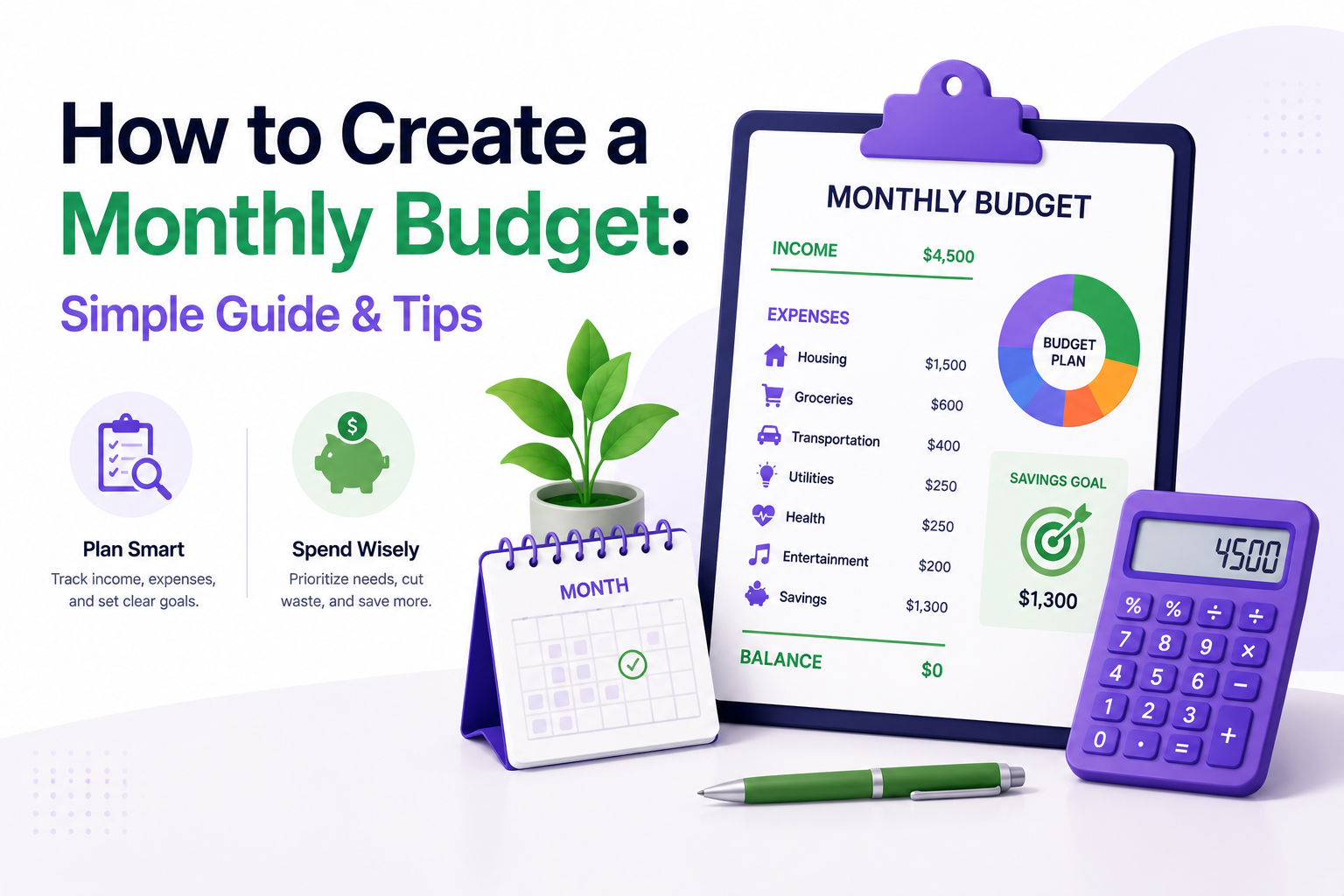
How to Create a Monthly Budget
Creating a monthly budget is one of the simplest ways to understand where your money is going and make a clear plan for the month ahead. A budget brings together your income, regular expenses, everyday spending, debt payments, and savings goals so you can see how much money is available for each purpose.
A monthly budget does not have to mean cutting out everything you enjoy. Instead, it gives you a framework for deciding how your money should be used before the month gets too far underway. When you know your expected income and expenses, it becomes easier to identify unnecessary spending, prepare for upcoming bills, and set money aside for future needs.
The basic process is straightforward: start by calculating your expected monthly income, list your expenses, separate essential costs from discretionary spending, decide how much you want to save, and then compare your planned spending with the money available.
The most useful budget is one that reflects your actual lifestyle. Instead of creating a spending plan based on unrealistic assumptions, use your previous bank statements, bills, receipts, and payment history to estimate what you are genuinely likely to spend.
Your budget can also change from month to month. Some expenses, such as rent or a regular loan payment, may stay relatively consistent, while groceries, transportation, entertainment, shopping, and other costs can vary. A good monthly budget allows room for these differences rather than expecting every month to look exactly the same.
Savings should also be treated as part of the plan rather than something you do only if money happens to remain at the end of the month. Including savings as a planned category can make it easier to build an emergency fund, prepare for large purchases, pay down debt, or work toward longer- term financial goals.
In this guide, we will walk through how to create a monthly budget from start to finish, explain which categories to include, show how to deal with irregular expenses, and discuss practical ways to keep your budget useful throughout the month.
Step 1: Calculate Your Monthly Income
The first step in creating a monthly budget is determining how much money you actually have available to work with. Your income is the starting point for the entire spending plan because your planned expenses and savings should fit within the amount you expect to receive.
If you receive a regular salary, start with the amount that reaches your bank account after deductions rather than your gross salary. The amount you can actually use for household expenses, savings, debt payments, and other spending is your take-home income.
If you are paid weekly, every two weeks, or on another schedule, convert your income into a monthly estimate. Avoid simply assuming that every month will contain the same number of paychecks if your payment schedule creates occasional months with additional pay periods.
Include All Regular Sources of Income
Depending on your situation, your monthly income may come from more than one source. This could include employment income, freelance work, business income, rental income, or other recurring sources of money.
Listing these sources separately can make your budget easier to review. It also helps you identify which income is predictable and which income may change from month to month.
How to Budget With Variable Income
Creating a budget can require more planning when your income changes each month. Freelancers, business owners, commission-based workers, and people with seasonal income may not know their exact monthly income in advance.
In this situation, you can use a conservative estimate based on your recent income history rather than assuming that your highest-earning month will repeat. This provides a more cautious starting point for essential expenses.
When income is higher than expected, the additional money can then be assigned according to your priorities. For example, you might direct some of it toward savings, debt reduction, upcoming irregular expenses, or other financial goals instead of immediately increasing discretionary spending.
Use Take-Home Income for Your Spending Plan
A practical monthly budget should normally focus on the money available to you after payroll deductions and other amounts that never reach your spending account. This gives you a more realistic picture of the money you can actually allocate.
Once you have calculated your expected monthly income, write down the total at the top of your budget. This number becomes the amount against which you will compare your planned expenses and savings.
Step 2: List and Organize Your Monthly Expenses
After calculating your income, the next step is to identify where that money needs to go. Start by listing every regular expense you can reasonably expect during the month. Looking at your previous spending history can help you avoid forgetting smaller expenses that may seem insignificant individually but become meaningful when added together.
A useful approach is to divide expenses into categories. This makes it easier to understand which costs are essential, which are flexible, and which expenses can potentially be reduced if your budget is tight.
Fixed Expenses
Fixed expenses are costs that generally remain the same or relatively predictable from month to month. Common examples include rent or a mortgage payment, certain insurance premiums, loan payments, subscriptions, and other recurring bills.
These expenses are often easier to plan because you already know the expected amount. However, they should still be reviewed periodically. A subscription or recurring payment that is no longer useful can quietly continue consuming part of your monthly budget.
Variable Essential Expenses
Some necessary expenses change from month to month. Groceries, electricity, transportation, fuel, household supplies, and certain utility bills are common examples.
For these categories, review several previous months rather than using one unusually high or unusually low month as your only reference. An average or reasonable spending range can provide a more useful starting point.
Discretionary Expenses
Discretionary spending includes purchases that are generally optional. Dining out, entertainment, hobbies, shopping, travel, and some subscriptions may fall into this category.
The purpose of identifying discretionary spending is not necessarily to eliminate it. Instead, separating it from essential expenses allows you to decide how much of your available income you want to dedicate to optional purchases.
Debt Payments
Include all required debt payments in your monthly budget. Depending on your situation, this may include credit card payments, personal loans, education loans, vehicle loans, or other forms of borrowing.
At a minimum, make sure your budget accounts for required payments by their due dates. If you have a debt repayment goal, you can also create a separate category for additional payments beyond the required amount.
Savings and Financial Goals
Savings should have a place in your monthly budget just like other categories. Depending on your goals, you might save for emergencies, future purchases, annual expenses, education, retirement, or other financial priorities.
Treating savings as a planned allocation can make your budget more intentional. Instead of waiting to see what is left after spending, you decide in advance how much you want to set aside.
Example Monthly Budget Categories
| Category | Examples | Budget Type |
|---|---|---|
| Housing | Rent, mortgage, maintenance | Essential |
| Food | Groceries, meals, dining out | Essential / Flexible |
| Transportation | Fuel, public transport, vehicle costs | Essential / Flexible |
| Debt | Loan and credit payments | Essential |
| Savings | Emergency fund, goals, investments | Financial Goal |
| Personal | Entertainment, hobbies, shopping | Discretionary |
The categories you use do not have to match someone else's budget. If you frequently spend money on a particular area, creating a separate category can make your spending easier to track. On the other hand, categories that are rarely used can be combined to keep the budget simple.
The goal is to create a system that gives you enough detail to make good decisions without becoming so complicated that you stop maintaining it. A budget only becomes useful when you can realistically follow and update it throughout the month.
Step 3: Set Spending and Savings Limits
Once you know your monthly income and have listed your expenses, the next step is to turn those numbers into an actual spending plan. A budget should tell your money where to go rather than simply record where it went after the month is over.
Start by adding up your essential expenses. These are the costs that you generally need to cover, such as housing, basic food, utilities, transportation, insurance, and required debt payments. Knowing this baseline gives you a clearer idea of how much income is already committed before you consider optional spending.
Next, decide how much you want to allocate toward savings and other financial goals. Savings can include an emergency fund, a planned purchase, future expenses, or long-term financial goals. The amount does not have to be identical every month if your income or expenses vary.
Give Every Dollar a Purpose
A useful budgeting approach is to assign your available income to specific categories until the planned amount has a clear purpose. This does not mean that every rupee must be spent. Money assigned to savings, debt reduction, or future expenses also has a purpose.
For example, if your monthly take-home income is ₹60,000, you might first account for housing, utilities, groceries, transportation, debt payments, and other necessities. You can then assign a planned amount to savings and decide how much remains available for discretionary spending.
The exact amounts will depend on your household, location, financial commitments, and goals. There is no single percentage that works perfectly for everyone, so use general budgeting rules as guidelines rather than strict requirements.
Set a Limit for Flexible Spending
Flexible spending is often where a monthly budget can make the biggest practical difference. Categories such as restaurants, entertainment, shopping, hobbies, and non-essential subscriptions can change considerably from one month to another.
Instead of trying to eliminate every optional purchase, set a realistic limit for these categories. A limit gives you freedom to spend while still keeping the overall monthly plan under control.
If your planned expenses exceed your income, discretionary categories are often a useful place to begin looking for adjustments. You can also review recurring bills and variable essential costs to identify other opportunities to reduce spending.
Create a Savings Target
Rather than treating savings as whatever remains at the end of the month, include a savings target in your initial plan. This makes saving a deliberate part of your financial routine.
You can divide savings into separate goals if that makes your plan easier to understand. For example, one category might be for emergency savings, another for a future purchase, and another for a longer-term financial objective.
If your current income does not allow you to save the amount you would like, start with a realistic figure rather than abandoning the goal completely. You can review and increase the amount later as your income, expenses, or financial priorities change.
Step 4: Plan for Irregular and Unexpected Expenses
One of the most common reasons a monthly budget fails is that people plan only for expenses that happen every month. In reality, many important costs occur only occasionally. Annual insurance payments, vehicle maintenance, medical expenses, gifts, school-related costs, travel, repairs, and festivals can all create larger expenses during particular months.
These expenses may not appear in a typical monthly list, but they still need to be included in your overall financial plan. Ignoring them can make a budget look balanced until an irregular bill arrives.
Make a List of Annual Expenses
Start by thinking about expenses that occur once or a few times each year. Review your previous year's bank statements, bills, and payment records to identify costs that do not appear every month.
Once you have identified these expenses, estimate the amount you will need during the year. Dividing an annual amount into monthly allocations can make large future bills easier to prepare for.
Use a Sinking Fund for Planned Large Expenses
A sinking fund is money set aside gradually for a known future expense. For example, if you expect to spend ₹24,000 on an annual expense, you could plan to set aside approximately ₹2,000 per month for twelve months, assuming the expense and timing remain as expected.
The advantage is that the expense does not have to come entirely out of one month's income. You prepare for it gradually, which can make your monthly cash flow more predictable.
You can create separate sinking funds for different goals, such as vehicle maintenance, annual insurance, holidays, gifts, education expenses, or home repairs.
Leave Room for Unexpected Costs
Not every expense can be predicted. A household appliance can stop working, a vehicle may need an unexpected repair, or another urgent expense may appear without warning.
This is where an emergency fund can provide an important layer of protection. Instead of relying entirely on credit or taking new debt when an unexpected expense occurs, available emergency savings can provide a source of funds for eligible emergencies.
Your monthly budget should therefore not be so tight that every rupee is already committed to routine spending. Leaving some flexibility can make it easier to handle changes without immediately disrupting your entire financial plan.
Step 5: Track Your Spending and Adjust the Budget
Creating a budget is only the beginning. To make the plan useful, you need to compare your actual spending with your planned amounts during the month. This helps you see whether your estimates are realistic and gives you an opportunity to make adjustments before the month ends.
You can track your spending using a spreadsheet, budgeting application, notebook, or another system that you are comfortable using. The tool itself is less important than consistently recording your transactions and reviewing them.
Compare Planned and Actual Spending
Suppose you budget ₹6,000 for groceries but spend ₹7,000 during the month. That does not automatically mean the budget failed. It may mean your original estimate was too low, prices changed, or you purchased items that were not included in your usual spending pattern.
The important step is to understand why the difference occurred. If the same category repeatedly exceeds the planned amount, you may need to increase its budget or find ways to reduce the underlying expense.
Review Your Budget During the Month
Waiting until the last day of the month to check your spending can make it difficult to correct problems. A quick weekly review can show whether you are moving too quickly through a particular spending category.
For example, if you have already used most of your entertainment budget halfway through the month, you can reduce spending in that category for the remaining weeks. This gives the budget a practical role in your everyday decisions rather than turning it into a report you only read after the money has been spent.
Adjust Categories When Necessary
A budget should be flexible enough to reflect real life. If one expense increases unexpectedly, you may need to reduce another category or use money that was deliberately left unallocated.
The goal is not to make every category match the original estimate perfectly. The goal is to make sure your overall spending remains aligned with your income and financial priorities.
At the end of each month, use what you learned to improve the next month's budget. If groceries were consistently underestimated, update the grocery category. If a subscription was barely used, consider whether it still deserves a place in your spending plan.
Example: A Simple Monthly Budget
A practical example can show how the different parts of a budget fit together. Suppose a person has a monthly take-home income of ₹60,000. The person wants to cover essential expenses, save regularly, and still have money available for discretionary spending.
The following example is only an illustration. Your own budget may look very different depending on your income, household size, location, housing costs, debt obligations, and financial goals.
| Category | Planned Amount | Purpose |
|---|---|---|
| Housing | ₹18,000 | Rent or housing costs |
| Groceries | ₹7,000 | Household food |
| Utilities | ₹4,000 | Electricity, internet, and other bills |
| Transportation | ₹5,000 | Fuel or transportation |
| Debt Payments | ₹6,000 | Required loan or credit payments |
| Savings | ₹8,000 | Emergency fund and financial goals |
| Personal Spending | ₹5,000 | Entertainment and discretionary spending |
| Irregular Expense Fund | ₹4,000 | Future and occasional expenses |
| Total | ₹57,000 | Planned monthly allocation |
In this example, ₹57,000 of the ₹60,000 monthly income has been assigned to planned categories. That leaves ₹3,000 unallocated, which can provide additional flexibility. It could eventually be assigned to savings, debt repayment, an upcoming expense, or discretionary spending based on the person's priorities.
The example also shows why a budget is more than a list of bills. Savings and irregular expenses are included alongside routine spending. This creates a broader picture of where the monthly income is intended to go.
If actual spending differs from the plan, the person can review the categories at the end of the month and update the next month's allocations. Over time, these adjustments can make the budget more accurate and easier to maintain.
Common Mistakes to Avoid When Creating a Monthly Budget
A budget can be difficult to maintain when it is based on unrealistic assumptions. Recognizing common mistakes can help you create a spending plan that is more practical and sustainable.
1. Forgetting Small Expenses
Small purchases can be easy to overlook when building a budget. A few small transactions may not seem significant individually, but repeated purchases can add up during the month.
2. Creating an Unrealistic Budget
Setting an extremely low spending limit may look good on paper but can be difficult to follow. If your actual spending consistently exceeds the target, review your assumptions and create a more realistic plan.
3. Ignoring Irregular Expenses
Annual bills, repairs, gifts, travel, and other occasional expenses should not be ignored simply because they do not occur every month. Planning for them in advance can reduce financial surprises.
4. Treating Savings as an Afterthought
If savings are not included in the initial plan, they may repeatedly get pushed aside by other spending. Giving savings a defined category can make the goal more visible.
5. Never Reviewing the Budget
Your financial situation can change. Income, rent, bills, family needs, debt payments, and personal priorities may all change over time. Reviewing the budget regularly allows the plan to change with them.
Frequently Asked Questions
1. What Is a Monthly Budget?
A monthly budget is a plan that organizes your expected income and expenses for a particular month. It can include essential bills, discretionary spending, debt payments, savings, and money set aside for future expenses.
2. How Much Money Should I Save Each Month?
There is no single savings amount that is appropriate for everyone. Your target depends on your income, expenses, debt, emergency savings, and financial goals. Choose an amount that fits realistically within your budget and adjust it as your circumstances change.
3. What Should I Do If My Expenses Are Higher Than My Income?
First, review the budget to make sure all income and expenses have been recorded accurately. Then separate essential expenses from flexible spending and look for categories that can be reduced. You may also need to review recurring payments or consider whether additional income is possible.
4. Should I Use a 50/30/20 Budget?
The 50/30/20 approach is one budgeting framework that divides income among needs, wants, and savings or debt repayment. It can be a useful starting point, but it is not a requirement. Housing costs, income levels, debt, family circumstances, and local costs can make different allocations more practical.
5. How Often Should I Review My Budget?
A quick weekly check can help you stay aware of spending, while a more detailed review at the end of each month can help you improve the next month's plan. The ideal frequency is one that you can maintain consistently.
6. Should I Include Debt Payments in My Budget?
Yes. Required debt payments should be included as part of your monthly expenses. If reducing debt is one of your goals, you can also create a separate allocation for additional payments when your budget allows.
7. What If My Income Changes Every Month?
If your income varies, consider building the budget around a conservative income estimate. When you receive more than expected, you can direct the additional amount toward savings, debt repayment, planned expenses, or other priorities.
8. Should I Track Every Expense?
Tracking your expenses can help you understand your actual spending habits and identify categories that regularly exceed your budget. However, the level of detail you use should be practical enough to maintain consistently.
9. How Do I Budget for Annual Expenses?
List the expected annual expense and estimate how much you need by the time it is due. You can then divide the amount across the months leading up to the expense and set aside money gradually.
10. What Should I Do With Money Left Over at the End of the Month?
If your planned expenses are covered and you have money remaining, consider assigning it according to your priorities. Depending on your circumstances, it could go toward savings, an emergency fund, debt reduction, an upcoming expense, or another financial goal.
Make Your Monthly Budget Work for You
Creating a monthly budget does not have to be complicated. The basic process is to calculate your available income, list your expenses, separate essential costs from flexible spending, include savings, and prepare for expenses that may not occur every month.
The most effective budget is not necessarily the one with the most categories or strictest limits. It is the one that accurately reflects your financial situation and is simple enough for you to maintain. Your spending plan should help you make decisions rather than make managing your money feel unnecessarily difficult.
Remember to review your actual spending against your plan. If a category is consistently higher than expected, investigate why and adjust the budget instead of repeatedly treating the difference as a failure. Your budget should improve as you learn more about your spending habits.
It is also important to plan beyond the current month. Setting aside money for irregular expenses and building savings can help you prepare for future costs instead of relying entirely on the next paycheck.
Most importantly, give your income a clear purpose. When you decide in advance how much should go toward essential expenses, personal spending, debt payments, savings, and future needs, you gain a clearer picture of your financial position.
A monthly budget is not a one-time document. It is a planning system that can change as your income, expenses, priorities, and goals change. Start with a simple plan, track what actually happens, learn from the results, and make the next month's budget more useful than the last.